 Amazon Global Store opening
You work hard to create a hit product.
Others copy it instantly.
You want to enforce your rights — but no registration, no evidence, no link.
This is the real dilemma many sellers face. Only when copied do they realize they lack copyright registration, creation records, or even the original published link. Enforcement becomes extremely difficult.
Copyright isn’t a distant legal term — it’s a weapon to protect your original work.
We’ve invited Ms. Yu Wenzhu, National Overseas IP Dispute Guidance Expert and Amazon IPA law firm partner at AnJie Broad, to help you prepare in advance.


Copyright protects text, images, paintings, photos, videos, music, and software code. For a scarf seller, original designs on scarves, packaging graphics, main images, model shots, lifestyle photos, brand stories, bullet points, manuals, promotional videos, and posters may all be copyrighted.

1. Originality: The work must be independently created by the author with minimal creativity.
2. Fixation: The work must be fixed in a tangible medium, capable of being seen, copied, or recorded.
Additionally, the author must be a human, not an animal or AI. If a seller generates a product image solely through AI prompts, they do not own its copyright and cannot stop others from using it. However, if the seller adds sufficient original contribution (e.g., editing with Photoshop), those contributed parts may be protected.
The following common cross-border e-commerce elements are not protected by copyright:
● Ideas (copyright protects a specific red-and-green apple pattern on a scarf, not the abstract idea of “a scarf with a red-and-green apple pattern”)
● Systems or operating methods
● Purely functional designs
● Public domain materials
● Short phrases
● Works whose copyright term has expired (terms vary by country)

Many sellers believe that without copyright registration, there is no copyright. This is false. In countries like the UK and EU, registration isn’t even available. Where it exists, it may carry limited weight. Copyright typically arises once an original work is created and fixed. Under the Berne Convention, works created in China are automatically protected in the U.S. and all Amazon marketplaces—even without registration.
Nevertheless, for sellers primarily targeting the U.S., timely U.S. copyright registration for original, easily copied elements is still meaningful. Benefits include:
1. To claim statutory damages and attorney’s fees in U.S. infringement lawsuits, registration generally must occur before infringement or within three months of first publication.
2. If registered within five years of first publication, the certificate serves as prima facie evidence in court.
3. For U.S. works, registration (approval or refusal) is usually required before filing an infringement lawsuit in federal court.
Many sellers create hits but, when copied, find they lack timely registration, creation evidence, or original publication links—posing severe enforcement challenges.
To protect your copyright, do the following:
1. Preserve creation process files, first-publication evidence, or timestamp proof. For example:
● Design source files
● PSD, AI, sketches, drafts
● Original photos, RAW files
● First drafts and revision records of copy
● Video project files
2. U.S. sellers should promptly register important original content.
3. Audit and manage copyright-related documentation. Review employment or outsourcing contracts with designers, photographers, and models to ensure copyright ownership clauses, and keep relevant agreements and communications. For content authorized by others, preserve license documents and verify the license scope. If multiple layers of authorization exist, ensure the chain is clear and complete.
Amazon provides a full suite of brand protection tools to help you proactively defend yourself. Establishing a compliance system for materials and an evidence retention mechanism is also key.
Take these 4 steps now to shield your account:
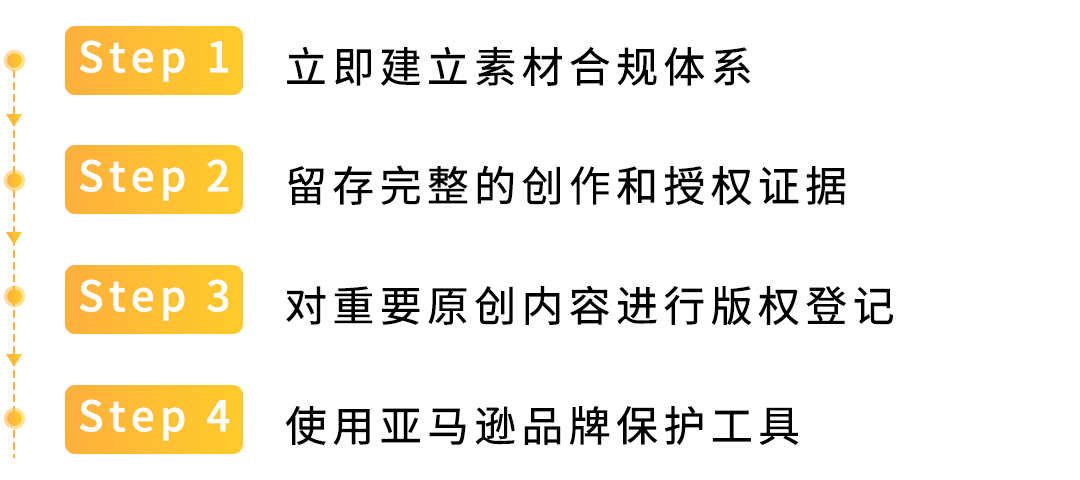
1. Enroll in Brand Registry to obtain brand ownership verification and activate automatic protection.
2. Establish daily monitoring and prepare a valid evidence chain. Report infringement promptly via Report a Violation or Project Zero.
3. Use the Transparency program to prevent counterfeits and piggybacking.
4. Seek professional services from qualified overseas lawyers through IP Accelerator.
Brand going global — protection comes first.
Better to prepare beforehand than remedy afterward.
Let this guide become the first cornerstone of your brand’s moat.
Tell us in the comments: what worries you most about copyright compliance? Have you faced a copyright complaint? We’ll answer in future articles, and we welcome your experiences and lessons to help more sellers avoid pitfalls.
For any Amazon questions, use the link (https://wsurl.cc/wg4chn) or scan the code to contact an official account manager: