 Seller's Home
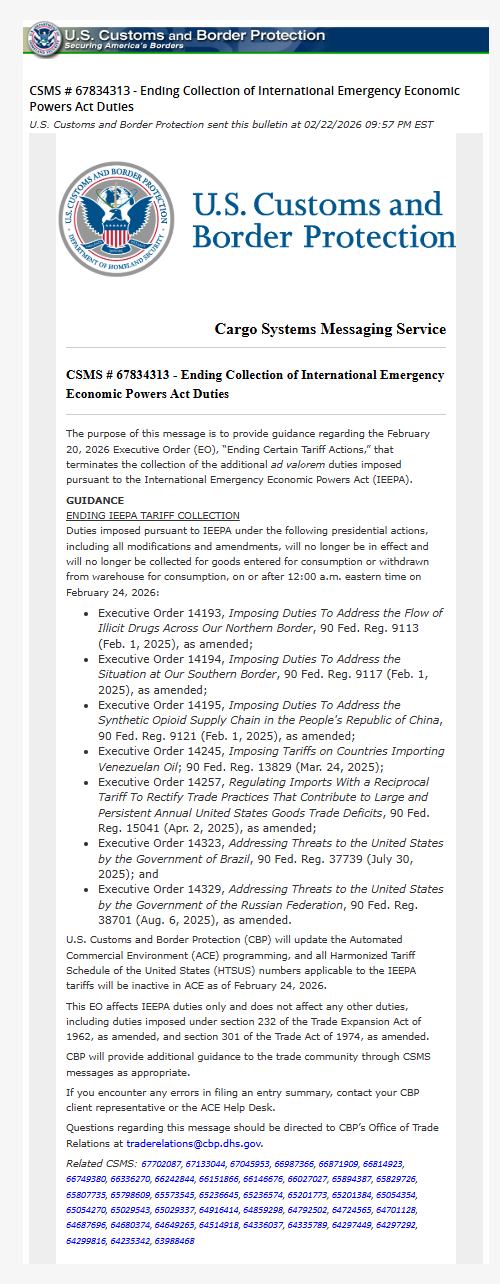
On February 22nd, local time, the U.S. Customs and Border Protection (CBP) officially announced that starting from 12:00 AM Eastern Time on February 24th, 2026, all import tariffs imposed under the International Emergency Economic Powers Act (IEEPA) will be suspended.
This regulation applies to goods that enter the consumer market or are withdrawn from warehouses for consumption immediately.
The suspension involves multiple executive orders previously signed by President Trump, including the Reciprocal Tariff and the Drug/Fentanyl-Related Tariff, which were imposed last year against any country including China. These additional tariffs will be officially terminated starting from 12:00 AM Eastern Time on February 24th, 2026.
The direct reason for the tariff suspension is the historic ruling made by the U.S. Supreme Court on February 20th. The Supreme Court ruled 6-3 that the Trump administration's actions in implementing large-scale tariff policies under the IEEPA exceeded the scope of legal authorization.
Chief Justice John Roberts pointed out in the ruling that the IEEPA authorizes the president to "regulate" imports but does not explicitly grant the power to impose tariffs, which is a "taxing power". He emphasized that allowing the government to exercise this power "would replace the long-standing collaboration between the executive and legislative branches in trade policy with unconstrained presidential decision-making". The court believes that such a significant change in economic power must be explicitly authorized by Congress.
CBP emphasized in the announcement that the suspension of this tariff does not affect any other tariffs imposed by the Trump administration. Tariffs imposed under Section 232 (National Security Clause) of the Trade Expansion Act of 1962 and Section 301 (Unfair Trade Practices Clause) of the Trade Act of 1974 remain valid.
It is worth noting that while the old tariffs are being abolished, new tariffs have taken over.
On the same day as the Supreme Court ruling (February 20th), President Trump signed a new executive order invoking Section 122 of the Trade Act of 1974, imposing a temporary import surcharge of 10% on global goods. This tariff took effect on February 24th and will last for 150 days. On February 21st, Trump further announced that the rate of this "global import tariff" would be increased from 10% to 15%.
As for whether the huge tariffs previously paid by importers can be refunded, there is still no conclusion. According to estimates by the Budget Model of the Wharton School of the University of Pennsylvania, the total amount of tariffs imposed under the IEEPA exceeds 175 billion U.S. dollars.
The information in this article is for reference only and should not be used as a basis for investment decisions