 Cross-border information
When people mention Anker Innovations, many first think of the “power bank leader” and its three main businesses: charging and energy storage, smart innovation, and smart audio/video. But Anker’s eye for investment is just as sharp.
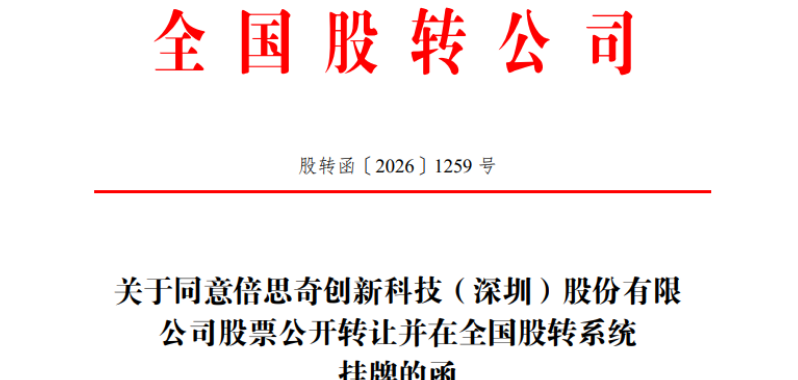
Recently, major Shenzhen-based seller BESQI Innovation Technology (Shenzhen) Co., Ltd., backed by Anker and focused on ergonomic and smart home products, was officially approved to list on the NEEQ (New Third Board).
According to data, BESQI's revenue reached RMB3.599 billion in 2025, with net profit of RMB73.486 million, making it one of the few leading vertical premium brands in cross-border e-commerce to complete a listing by 2026.
A hit product from an overlooked category
Public information shows BESQI was established in 2023, mainly engaged in R&D, design and sales of ergonomic and smart home branded products.
In fact, its story began in 2016. Founder Lyu Yaqi, an engineer by training, spent nearly two decades in manufacturing and AV supply chains.
Around 2016, cross-border e-commerce was booming and many sellers rushed into standardized products like phone cases and cables to compete on traffic. Lyu chose a category most people avoided—TV mounts.
The reason was simple: TV mounts test not only cost but also structural design, load-bearing safety, installation experience and supply chain coordination—exactly his strengths.
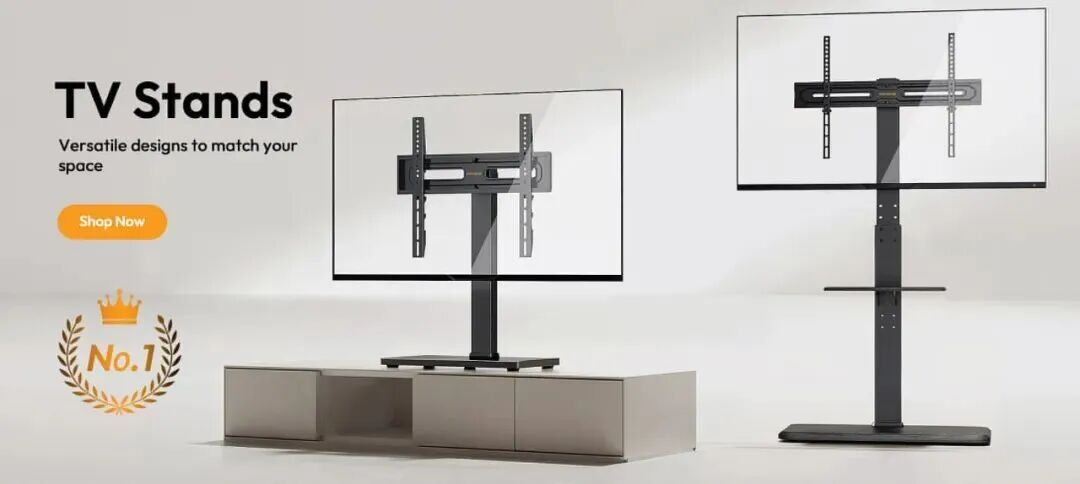
The first TV mount took two years to develop. It launched on Amazon US in 2017 and quickly became a hit, reaching No.2 in Best Sellers with monthly sales of up to $800,000.
After that, he did not rush to copy the model. Instead, he extended along real user scenarios: from TV mounts to monitor stands, then to standing desks and ergonomic chairs, solving pain points around the “workspace.”
In Lyu’s words, this is a “natural scenario loop.” Rather than chasing hot categories, he expands circles around one user space, stacking brand recognition among the same user group.
The returns show up directly in category position.
Data shows that in 2024 its HUANUO brand contributed over $300 million. Monitor stands and standing desks ranked No.1 in sales on Amazon US, with cumulative global users exceeding 44 million.
Anker, as an early backer, co-invested with IDG Capital in 2021 and still holds 1.79% as the sixth largest shareholder. This “top seller investing in a vertical player” is seen as a typical case in the industry.
The value behind RMB3.5 billion annual revenue
In brand matrix, BESQI centers on HUANUO, with PERLEGEAR, AMADA and Silonn as key brands. Categories cover office, AV, home and kitchen and garden, with a relatively diversified product structure rather than betting on a single hit product.
From 2024 to 2025, revenue rose 11.79% from RMB3.219 billion to RMB3.599 billion; net profit attributable to the parent surged 418.16% from RMB14.1822 million to RMB73.486 million; gross margin improved from 34.48% to 38.14%; operating cash flow turned from -RMB147 million to +RMB236 million.
Against the 2025 backdrop of destocking and intensifying price wars in cross-border e-commerce, this recovery shows that the vertical premium model has stronger resilience in cost control and brand repurchase than broad-based listings.
By channel, in 2025 Amazon accounted for 88.25% of revenue, and the US market accounted for 74.81%.
The highly concentrated structure allows it to fully exploit single-platform dividends and run refined operations, but it also leaves little buffer against channel volatility.
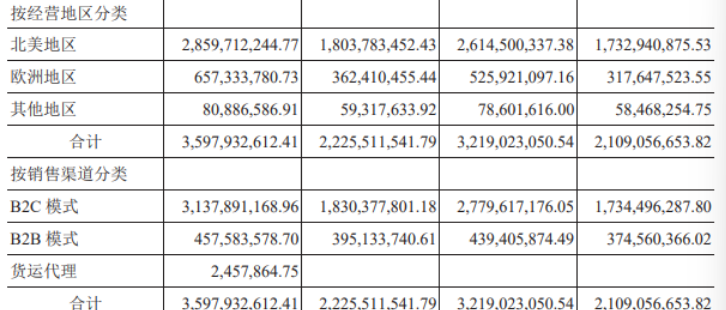
According to the company, it has started trying offline distribution through the acquisition of UK-based AVF Global, but the channel structure is unlikely to change in the short term.
Risks hidden in the financials
The results are impressive, but concerns remain.
The first weakness is low R&D spending.
In 2025, BESQI’s R&D investment was RMB42.3283 million, only 1.18% of revenue, while selling expenses reached RMB1.087 billion, or 30.22% of revenue—more than 25 times R&D spending.
This is common among Amazon brand sellers: platform traffic, advertising and warehousing costs keep eroding profits. In the financials, brand premium often shows up as high selling expense ratios rather than deep R&D moats.
The second weakness is the legacy tax issue involving third-party stores.
According to the public transfer documents, BESQI previously opened stores on e-commerce platforms through third-party companies, with related revenue and costs booked in its Hong Kong subsidiary. Those stores have now been closed.
The company has made provisions for income tax payable by the third-party store companies as required by tax authorities and has paid part of the tax, but some remains unpaid and it is communicating with tax authorities.
The documents also state that if it fails to pay as required, the company may face tax penalties.
This is a historical trace left by early cross-border sellers navigating between platform rules and tax compliance. BESQI is not alone.
But listing on a public market means such traces are no longer just internal costs; they become definite risks that must be disclosed to investors.
BESQI started from an 18-square-meter office and has reached today by deepening its products. Channel concentration, weak R&D and pending tax payments are all unavoidable topics on its listing path.
But its data also proves one thing: as traffic dividends fade and price wars intensify, sellers that truly master their products still have the confidence to move through cycles.
The real opportunity is not where the crowd gathers; it is reserved for those who have already built technical barriers.
SellerZhiJia Comment
The listing of Anker’s investee verifies the value of the “brand + capital” dual-wheel model. Sellers can study its category layout logic and examine whether their own supply chain and brand premium capabilities have the potential to attract capital.
Source: Cross-border E-commerce Headlines
Original link: https://www.amz123.com/t/3cV06oap