 Amazon Global Store opening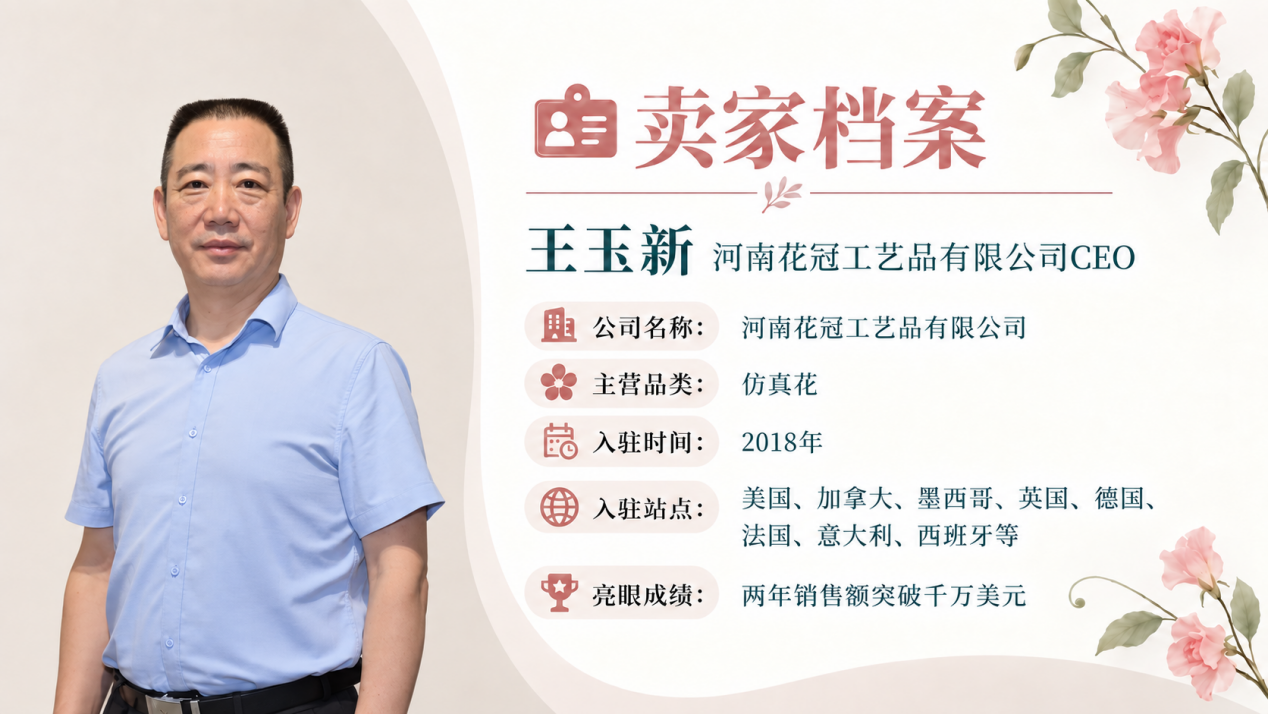
"Just you few people? How could you sell millions in a year?"
That's what a factory owner asked Wang Yuxin in Sheqi, Henan, in 2018 when he came to discuss cooperation.
Two years later, Huaguan's annual Amazon channel revenue surpassed $10 million for the first time, and has since maintained 20%-30% growth. A realistic soybean-flower design reached 1,000 orders per day, becoming a subcategory Best Seller.
These flowers start from Sheqi, a small county under Nanyang, Henan, and appear in overseas wedding aisles, arches, ceilings, dining tables, and bookshelves.
Eight years ago, few in Sheqi believed flowers could be sold abroad from a computer.

Wang previously ran cross-border businesses in wigs and lighting in Zhengzhou but quickly found he couldn't beat Xuchang in wigs or Guangdong in lighting. Competing head-on in others' strong arenas had no chance.
He looked for a new category with local industrial foundations in Henan and suitability for direct cross-border e-commerce sales.
At a large trade show, among seven or eight halls, nearly all were artificial flowers. "I immediately felt this market had huge potential."
In 2018, Huaguan was founded in Sheqi. Unlike most local companies relying on traditional foreign trade, Huaguan chose cross-border e-commerce from day one, selling Sheqi's artificial flowers directly to overseas consumers.

The first two years were tough. Production in Sheqi, operations in Zhengzhou; they gradually built the process from design to cross-border logistics.
The turning point came in 2020. COVID disrupted traditional trade but amplified cross-border e-commerce. As a whitelisted company, Huaguan maintained production and logistics, exceeding $10 million in annual channel revenue that year.
Orders became the most direct language. Factories that once refused samples began visiting. People who doubted online business began reassessing cross-border e-commerce.

"The best designer of artificial flowers is nature, and nature is the hardest to replicate," Wang said.
Leaf texture, petal layering, color gradient, even petal softness and touch—any deviation can make consumers label it "fake."
To get closer to nature, each flower goes through modeling, cutting, shaping, dyeing, and assembly. Different flower types need different materials and processes.

As products multiplied, how to manage them? Huaguan split its product line into two segments:
Core line: soybean flowers, vines, garlands—stable demand, suitable for long-term sales and reputation.
Expansion line: following overseas market changes, adjusting by season, holidays, and aesthetic trends to explore new scenarios.
Development cycles: about two weeks for minor tweaks, one month for new products. Seasonal decisions are made early—"think about next spring's products in the first half of the year."

Garlands are a typical example.
Initially, Huaguan saw garlands simply as door decorations. But from Amazon reviews, the team discovered customers inserting berries and daisies, or pairing them with white candles to create table centerpieces for family banquets.
A product already defined was reinvented by consumers.
Huaguan adjusted accordingly, adding new styles mixing greenery and buds, and selling with ribbons to leave more DIY space.
This is a deeper change from cross-border e-commerce: factories used to decide production on their own; now consumers keep participating in iteration after purchase.

Artificial flowers are highly visual products. Consumers cannot touch petals, so images and videos carry almost the entire task of "speaking for the product."
Huaguan built a visual team and introduced AI tools into image production, blending real product shots with overseas lifestyle scenes. "You want customers to imagine how the flower looks in their home the moment they see the image."

Soybean flower is Huaguan's star product. Its pea-pod-like blooms hang in clusters, suitable for wedding aisles, ceilings, photography sets, and everyday home décor.
A wedding often needs dozens or even hundreds of stems. Multi-pack sets fit the use scenario and raise average order value. After launch, it once sold 1,000 orders per day, becoming a subcategory Best Seller.

Key takeaways:
(1) Right track: Avoid mature tracks like Xuchang wigs and Guangdong lighting; choose artificial flowers with local industrial foundations suitable for cross-border e-commerce.
(2) Cross-border from day one: Skip traditional middlemen; reach overseas consumers directly through Amazon.
(3) Two-tier product management: Core line for stable growth, expansion line for trends.
(4) Consumer feedback drives iteration: Discover real usage from reviews and data, not just factory assumptions.
(5) Visuals are combat power: Artificial flowers sell "how real they look," so images and videos are core conversion weapons.
Today's Sheqi is very different from eight years ago. According to local authorities, artificial flower sales reached about 750 million yuan in 2024 and surpassed 1 billion yuan in 2025. Companies from Yiwu, Shantou, Xiamen and other places have settled, forming an industrial cluster around artificial flowers.
Huaguan is extending from C-end to B-end—some overseas merchants first purchase through Amazon to verify quality, then contact the team for bulk orders. Commercial clients like hotels and enterprises are also finding Huaguan through Amazon.
From a business nobody believed in to an industrial engine for a small county, this flower from Sheqi continues to bloom further afield.
If you have any questions about Amazon, you can use the link (https://wsurl.cc/wg4chn) or scan the QR code to contact an official client development manager: