 Cross-border e-commerce Hugo.com
Have you "raised lobsters" today?
The open-source AI agent known as "Lobster," OpenClaw, has seen its popularity soar over the past weekend. On March 8th, Longgang District in Shenzhen proposed the "Lobster Ten Articles" measures to support the development of OpenClaw and OPC (Note: One Person Company, a new model where individuals use AI technology to achieve lightweight and efficient entrepreneurship), adding fuel to the "Lobster" craze. OpenClaw, a geeky tool, has broken out of the developer community and injected new vitality into the highly competitive cross-border e-commerce industry.[Want to master OpenClaw practical skills and build AI Agent automated operation flywheel? The 2026 Amazon Global Store Spring Plowing Conference Shenzhen Station on March 25th will start. Exclusive OpenClaw practical sharing will teach you hands-on cross-border e-commerce automated operation.Click here to sign up]
On March 8th, the Longgang District Artificial Intelligence (Robotics) Bureau in Shenzhen released a draft of relevant support measures, introducing 10 support policies. These include encouraging the construction of "Lobster Service Areas," providing free deployment services, and offering subsidies up to 2 million yuan for core code contributions, skill package development, and embodied intelligence integration applications. Each year, demonstration application projects will be selected, and rewards up to 1 million yuan will be given based on 30% of actual investment to promote industrialization.
So, what exactly is OpenClaw, which is gaining attention beyond geek circles?
OpenClaw is an open-source AI agent that became popular at the beginning of this year. Known as the AI "Lobster" due to its red lobster-like icon, this tool, created by Austrian developer Peter Steinberg, breaks through the limitations of traditional AI that "only speaks but doesn't act." With its ability to autonomously execute complex tasks, it surpassed 250,000 stars on GitHub within just four months, outpacing Linux and React, becoming the fastest-growing open-source project in the platform's history. It has sparked layout and policy support from major companies, giving rise to innovative models like "One Person Company" and "Digital Doppelganger."
OpenClaw's core advantages are local deployment, open-source and free, and customizability. After obtaining permissions, it can fully take over devices and autonomously complete multi-step tasks such as file organization, email processing, and code writing. By controlling file systems, browsers, and API interfaces, it achieves full-process automation from creativity to implementation.
Amidst the popularity, industry layout accelerates: around the Spring Festival, major companies like Volcano Engine, Alibaba Cloud, and Tencent Cloud opened their cloud computing services; due to the complexity of local deployment configuration, door-to-door installation services even emerged domestically. On March 6th, nearly a thousand developers gathered at Tencent Building to complete cloud installations with the assistance of engineers.
A cross-border e-commerce seller told Hugo Cross-border that unlike traditional chatbots, this tool, centered on "autonomous task execution," with its local deployment, open-source and free, and customizable technical features, is expected to reconstruct the operation paradigm of cross-border e-commerce. This reconstruction covers the entire link from product selection, operation to customer service and marketing.
However, in practice, "raising lobsters" is not as simple as just downloading software. Since OpenClaw is essentially an intelligent agent operation framework, sellers usually need to prepare a running environment for it, such as deploying it on a separate computer or cloud server, and then connecting it to large language model computing power to enable it to understand instructions and execute tasks. The whole process usually includes steps such as downloading project code, configuring the running environment, connecting model interfaces, and setting permissions. Some users also connect it to instant messaging tools for easy interaction with the intelligent agent through chat instructions.
After completing the basic deployment, sellers often "train" the intelligent agent according to their business scenarios, that is, install different tool interfaces or functional modules for the intelligent agent to handle specific businesses. For example, in cross-border e-commerce operations, many sellers have connected product selection tool interfaces, spreadsheet systems, or data management tools to allow the intelligent agent to read operational data and execute corresponding tasks.
A seller who has been engaged in cross-border e-commerce for a short time shared his practical case. He started contact with cross-border e-commerce when he was at school last year. It took him about four months to make his store sell about 100,000 yuan a month. He was the only one who really put into the project. It can be said that he was the real "one-person company". In order to improve efficiency, he used a lot of AI tools in operation and tried to transform OpenClaw into an intelligent agent assistant specializing in cross-border business.
In the shipping process, this "lobster" mainly undertakes repetitive data processing work. For example, the seller only needs to tell the system the SKU and quantity to be shipped, and the intelligent agent will automatically extract the corresponding data from the operation table and fill in the logistics invoice and other documents. These steps, which used to require manual repetition, can now be completed automatically by the system, thereby reducing operational time consumption.
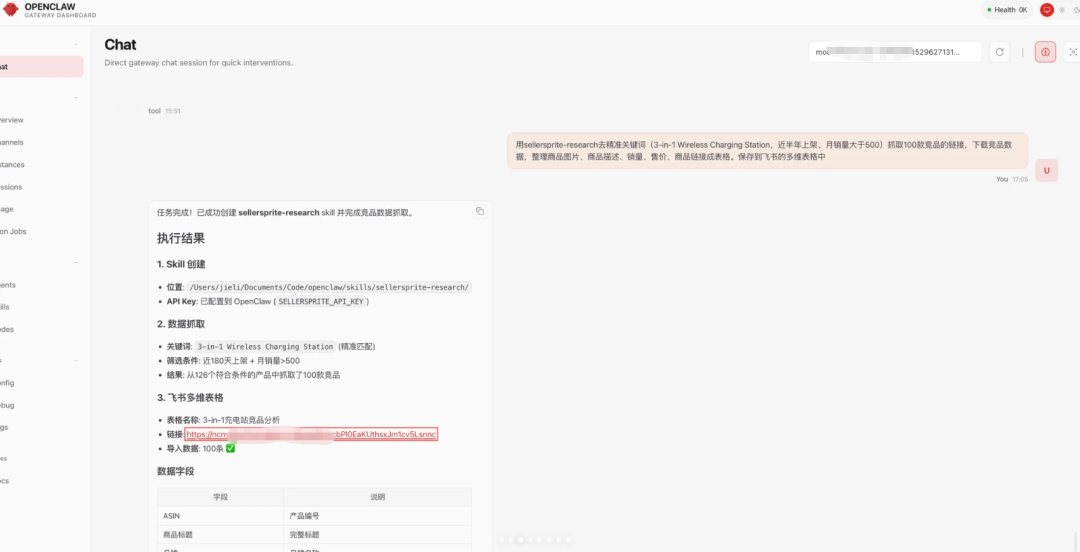
Image source: Screenshot of a book
In the product selection link, this seller also tries to use AI intelligent agents to integrate data from different sources.He will first obtain market data such as keywords, price ranges, monthly sales, and number of comments through product selection tools, and then the intelligent agent will automatically organize and store them in data tables. Subsequently, the system will further capture product reviews on e-commerce platforms and combine them with user discussions on community platforms for comprehensive analysis of products. The final report not only includes competitor situation, user feedback and market performance, but also summarizes potential product improvement directions and possible development opportunities.
In the eyes of sellers, the value of such AI intelligent agents is more reflected in "process automation".It can run continuously and process data collation, information synchronization and other work, while sellers can put more energy on product selection judgment and market strategy. For small teams with limited manpower, this kind of efficiency improvement has certain attraction.
However, while discussing the potential application value of OpenClaw, the industry generally maintains a cautious attitude.
The first is the technical threshold.Different from directly using AI tools on the web, OpenClaw requires local or server deployment and configuration of large language model services. The whole process involves code installation, command line operation and system permission configuration, which requires certain technical foundation. In addition, since the intelligent agent needs to continuously call the model to complete tasks, long-term operation will also generate certain computing power costs, which ordinary sellers need to evaluate in advance Input-output ratio.
The second is security risks.OpenClaw can perform operations on the computer, which essentially means that it needs to obtain higher system permissions. If the permission configuration is improper, or the intelligent agent is induced by malicious instructions, it may theoretically access local files or even perform deletion, modification and other operations. Therefore, it is generally recommended in the industry to deploy such intelligent agents on independent devices or test environments, and try to avoid direct operation on office computers storing core data.
At the same time, as the concept becomes popular, some commercial services around "Lobster AI" have also emerged. For example, charging deployment, remote installation and other services, some of which are only simple packaging of open source projects and do not provide additional technical capabilities. For users lacking technical experience, this also requires certain vigilance.
From a broader perspective, the popularity of OpenClaw reflects a trend - AI is gradually moving from "conversation tools" to "execution tools".In the cross-border e-commerce industry, this means that some operational processes may be taken over by automated systems, such as data collation, basic analysis or information monitoring.