
 Seller's Home
Recently, news of Amazon US FBA warehouse congestion has spread again among sellers.
Some sellers face a dilemma: after goods arrive in the US by sea and clear customs, they cannot be delivered into Amazon FBA warehouses. Some report that after trucking to the warehouse gate, capacity shortages and limited appointment slots force trucks to wait outside. Other sellers’ full-container goods still cannot be received after half a month at port, and top listings have been out of stock for seven days, causing keyword rankings to fall and ad performance to weaken.
However, it is worth noting that not all warehouses are congested.
01
Inbound receiving timelines have become much longer
According to warehouse appointment window data circulated on October 5, many warehouses on the West Coast, East Coast, and in the Midwest are seeing delayed appointments or no available slots.
LAX9 floor appointments are earliest on October 15 and pallet appointments on October 11, already congested. LAS1 floor appointments are pushed to October 20 and pallets to October 10. Warehouses including POC1, POC2, POC3, GEU5, IUSF, and PSC2 show pending appointments and congestion. CLT2, FTW1, MDW2, ABE8, AVP1, SWF2, and RDU2 have shifted to transfer status.
At the same time, some warehouses still have smooth inbound channels. ONT8 floor appointments can be made as early as October 6 and overall status is normal. LGB8, SBD1, XLX7, GYR2, GYR3, SMF3, SCK4, GEU2, GEU3, VGT2, MIT2, TCY2, ABQ2, and RFD2 all have relatively early floor appointments. Some warehouses are split: IUSP floor appointments are tight but pallet appointments are normal, while ONT8 floor appointments are smooth but pallet appointments must wait until October 11.
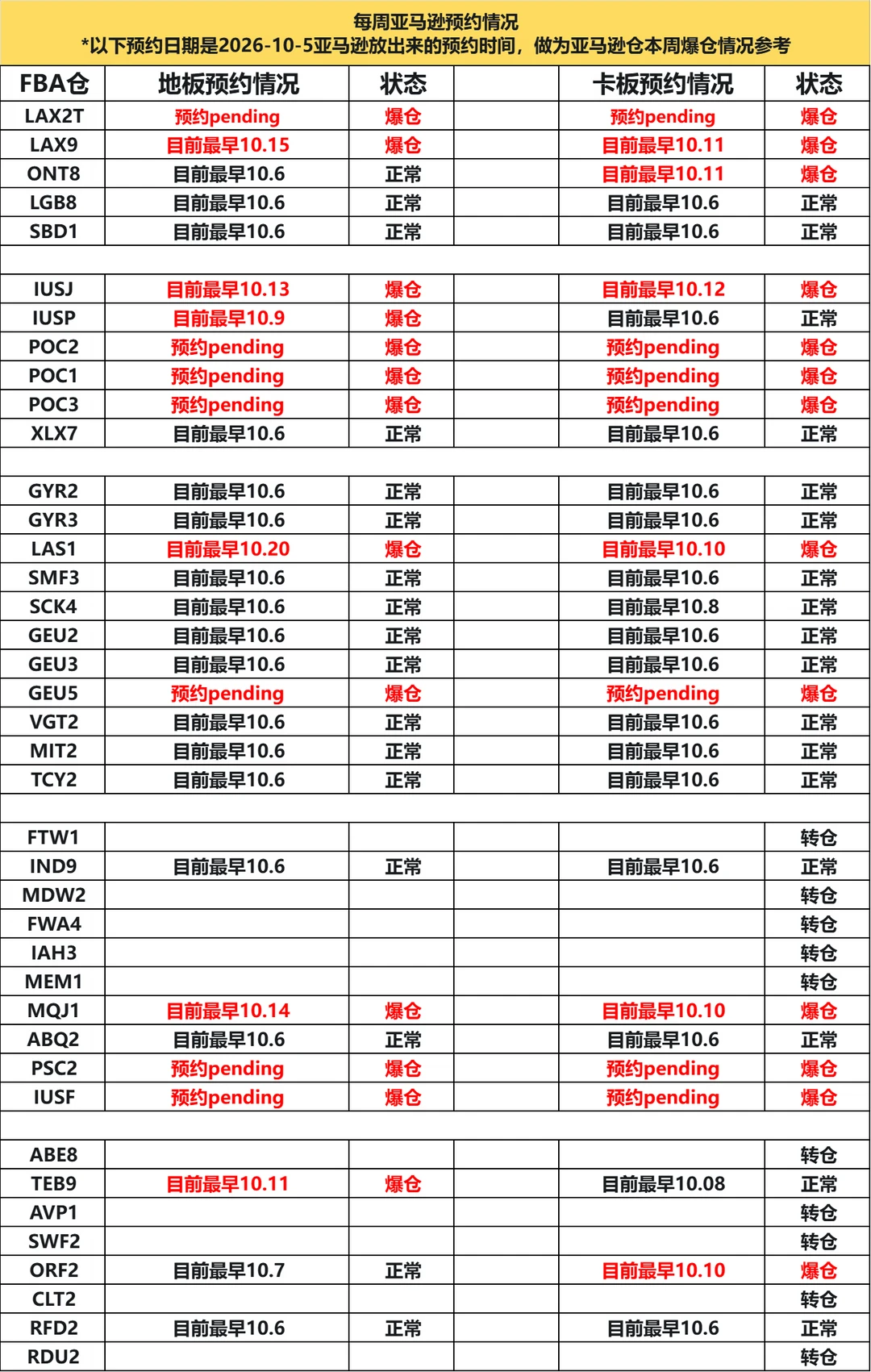
Fortunately, the congestion is not universal.
Some sellers say that of two warehouses in the same region, one received goods normally while the other could not even get an appointment. One seller said bluntly: “It is not that there is no inventory; it is that goods cannot get in.” Others report that some warehouses release appointment slots at irregular times, and slots disappear if they are even slightly slow.
For sellers, appointment difficulties mean more than waiting a few extra days in logistics. If goods clear customs but cannot be scheduled for inbound, inventory cannot quickly become sellable.
Some sellers are already seeing stockouts because of stranded goods. Once a stockout occurs, keyword rankings, ad performance, and peak-season traffic are all hit. Even after replenishment arrives, these metrics are hard to restore quickly.
02
Sellers’ inventory plans are being forced to change
More notably, the platform has also tightened inbound standards.AWD transfer warehouses are now restricting large-item inbound, and some receiving permissions have been closed. For small and medium sellers, there are few backup storage options, so when one link is blocked, the entire replenishment rhythm is delayed.
Some sellers had planned to store large goods in AWD transfer warehouses first and transfer them to FBA after capacity eased, but this no longer works, so they must find third-party overseas warehouses. Others calculate that although overseas warehouses add handling and storage fees, the situation is more controllable than leaving goods stuck at ports or outside warehouses indefinitely.
Facing tight capacity, sellers are taking different approaches.
Some choose to wait, refresh appointment pages daily, adjust shipment settings, and contact Amazon support to try to secure slots. Some switch to overseas warehouse transfer, storing goods in controllable third-party warehouses and dispatching them once FBA appointments improve. Others slow outbound shipments, keeping goods intended for FBA in China while monitoring capacity changes.
Some sellers are trying self-help measures such as changing receiving addresses, switching target warehouses, and splitting shipments into smaller ones. Results are mixed: some shipments enter successfully while others remain stuck. Many believe that instead of passively betting on Amazon capacity recovery, it is better to place goods in storage nodes they can control.
During capacity shortages, sellers are easily pushed into temporary changes: switching warehouses when appointments are delayed, or blindly increasing shipments out of stockout fear. But making inventory plans based on a single day’s appointment data can overlook extra costs from transfers, final-mile logistics, and inventory reallocation. An available appointment window does not mean the entire supply chain is smooth, and an early appointment does not guarantee on-time shelf availability.
Industry practitioners advise: for products with stable sales and heavy peak-season traffic, inventory planning should not simply back-calculate replenishment from ideal inbound dates. For new products and categories with high inventory turnover pressure, control replenishment carefully to avoid large quantities stuck in transit without generating sales. When evaluating warehouse conditions, do not simply label them “congested”; consider appointment windows, packaging types, and transfer rules comprehensively.
The platform has not issued an official announcement about this round of capacity tightness. Judging from delayed appointment systems and widespread transfer mode, platform resources are likely being prioritized for key promotional inventory, squeezing ordinary sellers’ routine replenishment. Sellers need to prepare plans in advance to narrow the gap between inventory planning and actual inbound results.
This article is for analysis only and does not constitute investment advice.