
 Seller's Home
The fall Prime Day 2026 has arrived as scheduled, but seller circles are showing a strange sense of polarization.
On one side, some sellers posted backend order timestamps stuck at "52 minutes ago" and "41 minutes ago," suspecting that the system may have another small bug. On the other side, some sellers are enjoying explosive orders, while others are seeing dismal order volumes and starting to review what went wrong.
01
Some wait for orders, some enjoy a surge
According to seller feedback, this year's fall promotion feels significantly more polarized than in previous years.
At 9 a.m. today, some sellers reported that Amazon's backend had no new orders for nearly an hour across several stores. Refreshing kept showing orders from about 50 minutes ago, while current orders would not appear. Another seller mentioned that all five company stores had orders from more than 50 minutes ago; refreshing a while later would pull up orders from an hour ago, showing an obvious time lag.
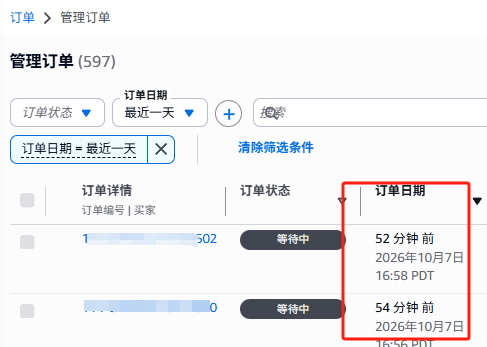
Image source: Zhiwubuyan
Similar discussions quickly spread through seller circles. Many people's first reaction was: has Amazon's system crashed again?
But soon, some sellers observed that sales in business reports had actually increased, possibly because the data volume was large and the system was delayed.Later, sellers gradually reported that orders began to appear, but updates remained heavily delayed.
From this feedback, it looks more like a minor hiccup during the peak of a big promotion rather than a sudden disappearance of demand. Brief data synchronization delays during order peaks are not rare on platforms; this year it just happened to coincide with Prime Day, amplifying seller anxiety.
However, compared with the system hiccup, the divergence in order volume among sellers sparked a wider discussion.
Some sellers said bluntly that this year there was no order explosion, but advertising costs exploded, storage and delivery fees also rose, and profits were severely squeezed. Some reported that certain listings performed even worse: normally averaging 10+ orders per day, they had only two orders during the event. Others said category rankings stopped updating and organic positions did not move, making the promotion feel as if it had never happened. Another seller mentioned that combined with sluggish traffic in the previous two weeks, many goods started piling up in October, and the profit calculation showed a huge loss.
But not all sellers saw sluggish order volumes.
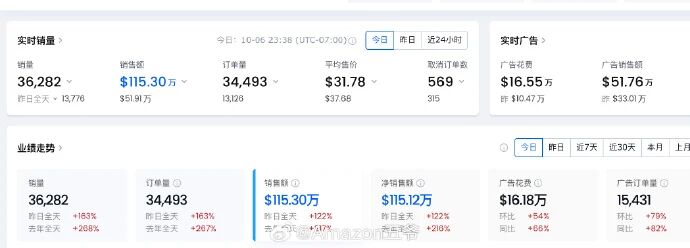
According to feedback in groups, some large sellers saw order volumes surge 20 times. Some sellers observed that most participating top listings increased sales by 3 to 4 times, while non-participating listings also rose by about 1.5 times. Some felt that far fewer sellers enrolled in BD this time, and overall performance was more explosive than Prime Day. Small sellers said they did not participate at all and saw no difference in sales, but they still caught a bit of the event tailwind, with sales slightly higher than the previous two days.
One seller summarized the promotion this way: "Participating top listings grew 3 to 4 times, non-participating ones grew 1.5 times, but profits are lower year after year, and competitors are constantly cutting prices."
Meanwhile, discussions about promotional price rules are also unfolding in seller circles. Many sellers worry that if they did not get into the fall promotion in Z Deal and can only submit Prime member prices under price discounts, which require prices to be at least 5% below the lowest price, whether that will affect Black Friday pricing.
Most sellers believe the lowest price is only captured within one month, while reference prices and median prices are captured from the past 1-2 months. Some sellers explicitly stated that promotional prices during platform big sales will not affect the 30-day lowest price or the 90-day median price.
Overall, big promotions are no longer a universal dividend where everyone gets explosive orders; order volume is becoming increasingly differentiated.
02
Demand is still there, but consumers are more budget-conscious
Latest research from consumer data and technology company Numerator shows that economic pressure has intensified consumer focus on discounted products. This means demand has not disappeared; only consumer decision-making is changing.
During last year's Prime Day promotion, high-income households accounted for as much as 46% of spending, while this year they are showing greater interest in daily essentials and private-label goods. Data show that in spending during the 2025 Prime Big Deal Days and 2026 Prime Day, high-income households accounted for nearly half of spending, and they are also the income group most likely to shop during this year's Prime Day.
Compared with low-income households, high-income households are 34% more likely to plan purchases of Amazon private-label products and 30% more likely to stock up on daily necessities. This shows that even groups with stronger purchasing power tend to favor practicality and value during big sales.
The competitive landscape is also changing. Walmart has become Amazon's main competitor. During last year's Amazon Prime Day, Amazon users spent nearly $400 million at competing retailers, and total spending on Walmart and Target websites was also close to $400 million, up 67% from the previous week.
High-income households accounted for more than 42% of total cross-shopping spending across Amazon, Walmart, and Target.
In other words, consumers have not stopped shopping; they are just spending some money elsewhere. For sellers, this creates a feeling that "platform traffic has declined." Demand is still there; it is simply being split across more channels.
Additionally, artificial intelligence is affecting how consumers discover deals, especially among high-income consumers. Nearly a quarter of consumers plan to use AI for shopping during Amazon Prime Day. Low-income consumers are about equally likely to shop using Alexa and to use AI tools outside Amazon, while high-income households are twice as likely to use non-Amazon AI tools as to use Alexa. This means consumers' price comparison and discovery paths are becoming more diverse, and the platform is no longer the only entry point.
In terms of categories, daily essentials remain the main products purchased during Amazon Prime Day. More than half of consumers said Prime Day has become an important part of holiday shopping, with clothing, toys, and home goods as the top gift categories they plan to buy.
Consumers are not refusing to buy; they are more rational, more price-conscious, and more cross-platform. For sellers, the era when simply relying on big-sale traffic could trigger an order explosion is fading. Understanding consumers' actual decision paths is more important than staring at backend order numbers.
This article is for analysis only and does not constitute investment advice.