 Yijia Overseas
The 2027 official fees for the French Packaging EPR have been announced. Citeo and Léko, the two major eco-organizations, have adjusted their fee structures, with higher rates for some packaging materials and changes to minimum declaration fees.
For cross-border sellers operating in France, the key question is not just how much official fees have risen, but how much their own compliance costs will increase — and whether Citeo or Léko is the better choice.
Yiju Overseas reviews the 2027 fee changes, the declaration logic of the two schemes, and practical responses, to help sellers estimate compliance costs and plan EPR filings for the French market.
1. Which sellers are affected? Do they need to make back payments?
France's Packaging EPR fee adjustments mainly affect businesses that place packaged goods on the French market. Cross-border e-commerce sellers cannot simply rely on whether they have a French company to determine their obligations.
1.1 Which sellers are affected?
Any seller placing applicable packaged goods on the French market should verify its EPR obligations.
1.2 Will the 2027 fee increase require back payment?
A higher 2027 rate does not mean all sellers must immediately pay additional amounts.
The published 2027 household packaging EPR rates apply to packaging placed on the market in 2027, which is normally declared in 2028. Therefore:
Sellers that have already completed their 2026 annual declaration will not automatically owe 2026 supplementary fees just because the 2027 rates changed. If previous omissions, underreporting, or inaccurate information exist, sellers should verify whether supplementary filing or payment is required based on the relevant declaration year, contract, and regulations.
2. Which Packaging EPR fees have changed, and by how much?
Not all 2027 packaging EPR fees have increased. Minimum fees, weight-based fees, and per-unit fees have changed in different ways.
2.1 Minimum fee: Léko rises from €95 to €110
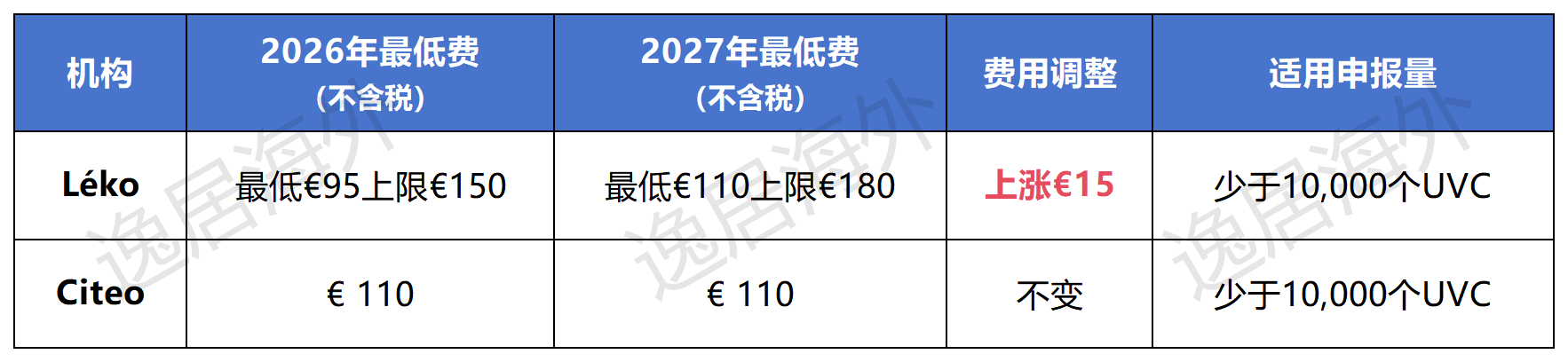
According to the fee comparison updated on 8 October 2027:
Citeo: the fixed declaration fee for fewer than 10,000 consumer sales units (UVC) remains €110.
Léko: the minimum fee rises from €95 to €110; the simplified declaration cap for fewer than 10,000 UVC is adjusted to €180.
2.2 Weight-based fees: common materials rise slightly, PVC rises sharply
The comparison below shows some material rates for 2026 and 2027, in euro cents/kg, excluding tax.
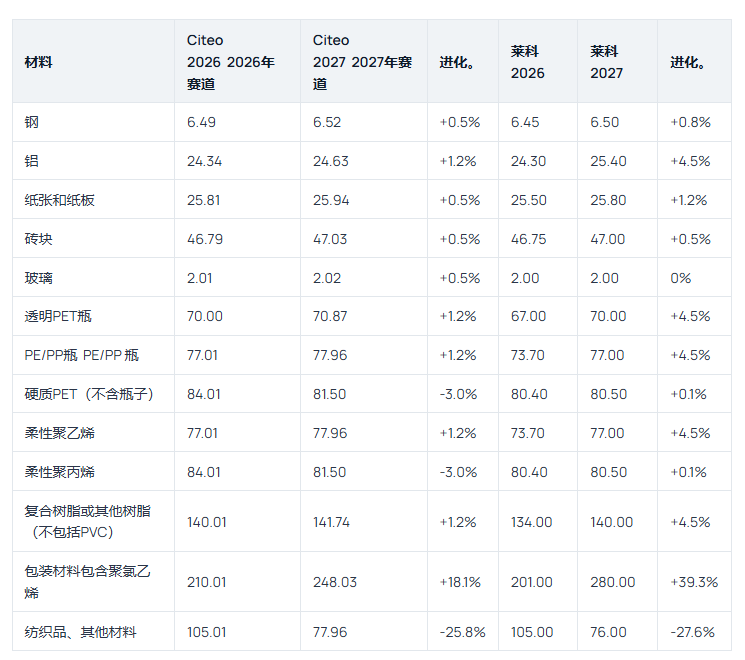
For common cartons and cardboard, weight-based changes are relatively limited, but PVC packaging charges have risen substantially.
Sellers using plastic bags, plastic bottles, composite materials, or special packaging should not focus only on the minimum fee; they should estimate costs based on actual packaging materials and weight.
2.3 Per-unit fees: some items have decreased
Packaging EPR may also involve charges per consumer sales unit (UVC).
In the 2027 adjustment, some per-unit charges under Citeo and Léko have decreased, but changes vary by product category, packaging structure, and declaration method.
Therefore, it is not accurate to say that all French packaging EPR fees will rise in 2027. Sellers should recalculate payable amounts based on product category, packaging quantity, weight, and applicable rates.
3. How do Citeo and Léko differ in declaration logic?
3.1 Citeo: method depends on declared volume
Citeo mainly uses the annual number of consumer sales units (UVC) placed on the French market to determine the declaration method:
Fewer than 10,000 UVC: a fixed fee of €110;
10,000 to 500,000 UVC: simplified declaration, calculated by product category and applicable rates;
More than 500,000 UVC: detailed declaration, calculated using packaging materials, weight, and packaging unit data.
3.2 Léko: simplified and detailed paths
Léko also provides two main declaration methods:
Simplified declaration: for companies placing fewer than 500,000 UVC on the French market per year, calculated by product category and unit rates.
Detailed declaration: declared by packaging material weight and UVC quantity, suitable for companies that need to calculate fees based on actual packaging structure.
4. How should cross-border sellers choose?
Case 1: Annual sales below 10,000 UVC
Compare fixed fees first. If Citeo charges €110 and Léko would charge more based on actual results, Citeo may be more suitable. If Léko also comes to €110, the base fees are the same.
Case 2: Annual sales between 10,000 and 500,000 UVC
Compare the simplified declaration rates first. Léko's rates may be lower for some common categories, but Citeo has also lowered some 2027 rates. Sellers should calculate item by item rather than choose by provider name alone.
Case 3: Annual sales above 500,000 UVC
Compare detailed declaration options for both. Sellers should organize packaging material weight and the number of packaging components per UVC, then combine weight-based and unit-based charges. Those with complex packaging or a high share of PVC should pay special attention.
5. How should sellers respond to the adjusted Packaging EPR fees?
5.1 Recalculate declaration fees
Using the latest 2027 rates, recheck annual UVC volume, packaging materials, and weight. Compare Citeo and Léko charges and budget costs in advance.
5.2 Check existing declaration information
Verify packaging quantities, material classification, and EPR registration details. If omissions or underreporting are found, confirm supplementary filing and payment requirements.
5.3 Prepare compliance in advance
Unregistered sellers should first confirm applicable EPR categories and declaration obligations; registered sellers should assess whether their declaration plan needs to change under the new rates.
5.4 Non-French companies should verify representative requirements
If the business is not established in France, in addition to EPR fees, check whether a qualified French authorized representative is required and whether registration and declaration procedures are complete.
Final note:
Cross-border sellers should complete 2027 fee estimates as early as possible, check existing declaration information, and choose a suitable declaration plan according to product category and business size, to avoid underestimating compliance costs or missing declarations that may affect their French market operations.
The above is shared by Yiju Overseas. Feel free to leave comments below!