
 Yijia Overseas
EU cross-border e-commerce import rules are changing again!
From November 1, 2026, the EU will charge a Union Handling Fee (UHF) of €2 per item on e-commerce goods entering from outside the EU. Unlike the previous €3 temporary tariff on low-value parcels of €150 or less, this handling fee has no value threshold and may apply to goods of any value.
What sellers should note even more is that this fee is non-refundable in principle. Even if goods have quality issues or consumers return them, the handling fee cannot be refunded on that basis.
For sellers targeting Europe and using direct cross-border fulfillment, logistics costs, pricing, and return costs all need to be reassessed.
1. When will the EU €2 handling fee take effect?
According to the EU Commission's customs reform guidance and information published by Irish Revenue and Customs, the €2 handling fee will apply from November 1, 2026.
It mainly covers customs costs for processing e-commerce parcels, including data verification, risk analysis, document review, and necessary physical inspection.
Note that the €2 handling fee is not the same as the already implemented €3 temporary tariff; they are two separate charges.
2. What is the difference between the €2 handling fee and the €3 tariff?
From July 1, 2026, the EU has applied a temporary tariff of €3 per item to eligible low-value imported e-commerce goods valued at €150 or less.
From November 1, the new €2 handling fee will also be implemented, with no value threshold.
The main differences are as follows:
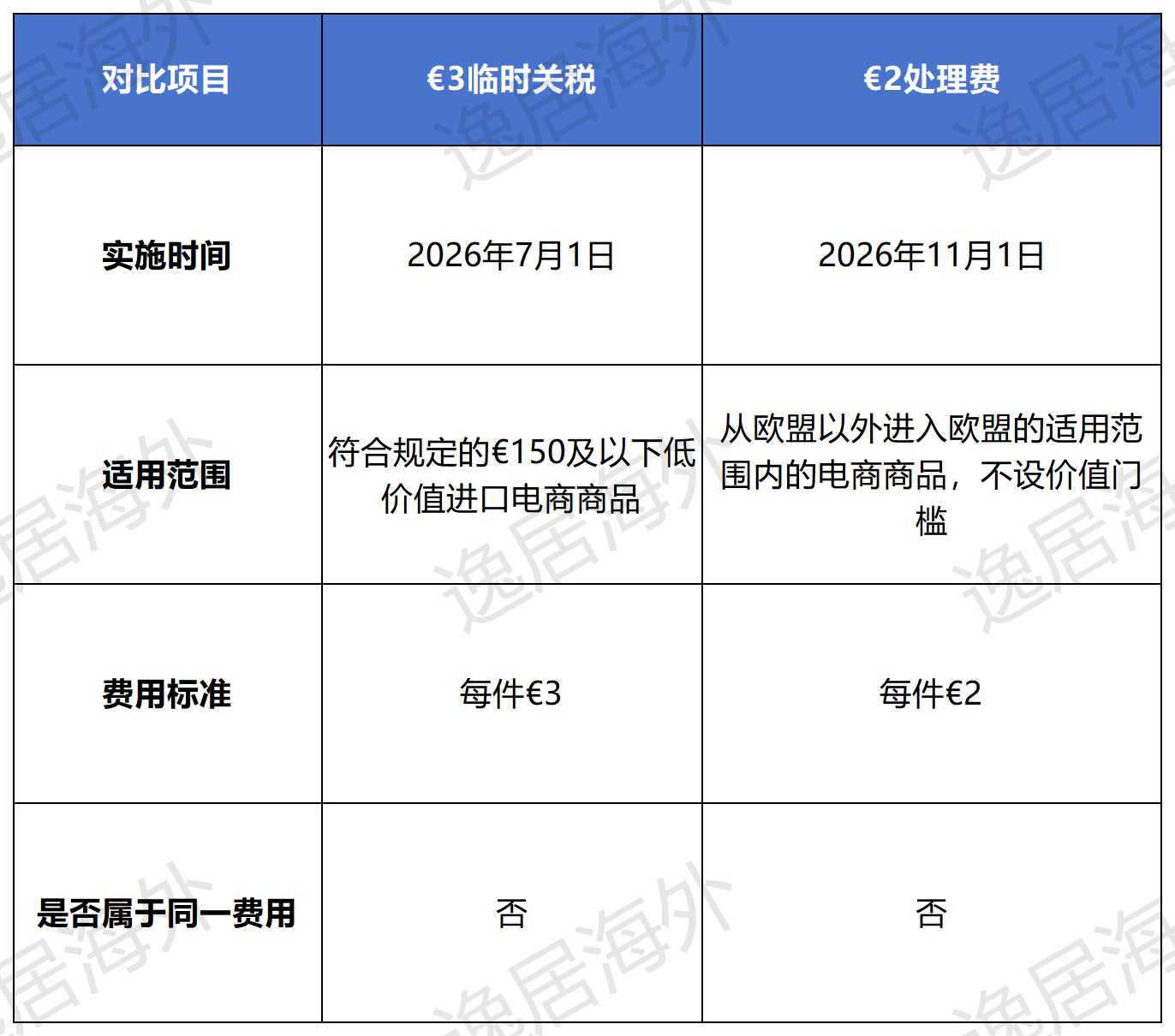
For goods meeting both charges, sellers need to consider both fees.
For example, a product shipped directly from China to the EU with a declared value of €20 may incur €5 from these two fees alone if both apply.
This €5 does not include VAT, applicable customs duties, freight, or other logistics costs. Actual charges depend on the product, transaction, and declaration.
3. The €2 handling fee is not limited to parcels under €150
Many sellers have focused on EU low-value parcel tariffs and may assume the €2 handling fee only applies to goods below €150.
According to current official guidance, the €2 handling fee has no value threshold.
In other words, sellers cannot assume that goods priced above €150 are automatically exempt from this fee.
For cross-border direct sellers, whether selling low-ticket or higher-priced goods, they should check whether their logistics and import arrangements meet the fee conditions.
They should also distinguish business models: e-commerce parcels shipped directly from outside the EU to EU consumers, and orders shipped from warehouses already located in the EU, have different import stages and fee timing, so they cannot be treated as the same.
4. Can the €2 handling fee be refunded if consumers return goods?
According to the official explanation published by Irish Revenue and Customs on September 30, 2026, the €2 handling fee is non-refundable.
Even if goods have quality problems or consumers request returns, the handling fee cannot be refunded.
This means returns may bring not only reverse logistics costs, product damage, and after-sales costs, but also make the import handling fee an unrecoverable cost.
Sellers of clothing, footwear, home goods, and other categories with higher return rates should pay special attention to this change.
Note that the above official explanation comes from Irish Revenue and Customs. In practice, sellers should also check the formal rules and platform implementation arrangements for the specific transaction and destination, and avoid applying one jurisdiction's details to all scenarios.
5. How should cross-border sellers respond?
1. Recalculate product profit for European sites
Include the €2 handling fee in cost calculations, and reassess profit margins for different SKUs by combining selling price, purchase cost, first-leg freight, platform commission, VAT, return rate, and other factors.
For low-ticket items, fixed fees may account for a higher share of the selling price, so thin-margin products should be checked first.
2. Review logistics and inventory models
Distinguish direct shipping from China, third-party overseas warehouse fulfillment, Amazon FBA, and other models. Clarify where goods complete import clearance, who bears relevant fees, and how platforms or logistics providers handle new charges.
Note that overseas warehouse models do not automatically exempt goods from import fees; the key is the actual import arrangement when goods enter the EU.
3. Check platform charges and customs arrangements in advance
Watch for notices from Amazon, Temu, SHEIN, eBay, and other platforms, and verify fee allocation among platforms, sellers, and logistics providers.
Also check customs declaration data, declared value, import responsibility parties, and logistics bills to ensure charges are clear and avoid duplicate billing or missed costs.
4. Reassess return costs
For high-return products, include the non-refundable handling fee in return cost models, and improve product descriptions, size information, quality control, and after-sales processes to reduce returns caused by insufficient information or quality problems.
Final thoughts:
From the €3 temporary tariff on goods of €150 or less, to the €2 handling fee with no value threshold, and the possibility that fees cannot be recovered after returns, sellers need to calculate costs, review logistics models, and prepare for compliance in advance.
For cross-border sellers planning to continue growing in Europe, keeping up with policy updates, clarifying import responsibilities, and managing tax and costs are key to adapting to the changes brought by the new rules.
This is the sharing from Yiju Overseas. Feel free to leave a comment and discuss!