
 Yijia Overseas
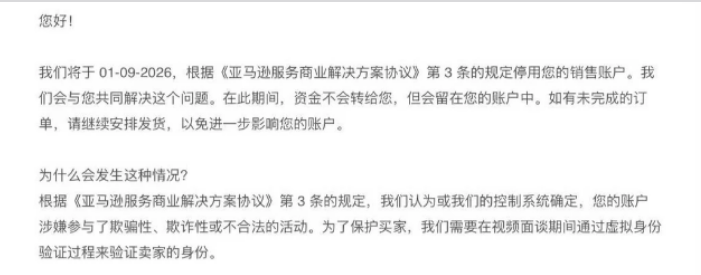
Amazon has begun a platform-wide retroactive review led by its AI risk control system. A large number of sellers have received "Section 3" account suspension notices, with selling permissions removed, listings grayed out, and account funds fully frozen.
1. How is this different from previous sweeping suspension waves?
The biggest difference is the shift from "single violations" to "overall account credibility." In the past, typical cases were:
1. Product infringement → remove the product or close the store;
2. Authenticity complaints → provide invoices and supply chain documents;
3. Linked accounts → identify the linked store and then handle it;
4. Performance violations → fix specific metrics.
Now the scope of "Section 3" is clearly much broader. The suspension reason is not limited to one type of violation. Some involve account linkage, some involve identity verification, some involve product authenticity, and some involve risks such as fraud and illegal activity.
More notably, some notices directly state: Amazon will make decisions using automated tools combined with manual expert review.
So it is now more like: the system detects an anomaly → the risk model tags it → manual or document review is triggered → Section 3 is enforced.
2. Which accounts is AI actually watching?
① Identity information that does not match
Company name, registered address, actual business address, legal representative/beneficial owner, payout information, credit card information, phone number, ID documents, and business license. Obvious inconsistencies at different stages may trigger further review.
② Linkage signals between multiple accounts
This is a very typical Section 3 category: the current account is suspended because it is deemed linked to another account that previously violated policies. Before reinstating the current account, the linked account must be resolved first.
Sellers should pay special attention: the platform may judge whether accounts are related from multiple dimensions.
③ Abnormal address, entity, or payment information
Especially logical inconsistencies among company address, business address, payment entity, credit card, and bank account information.
If one entity presents contradictory information in multiple places, the risk will clearly increase.
④ Identity verification that cannot form a closed loop
The documents submitted during registration tell one story; the answers during video verification tell another; and the legal representative, company business, and product supply chain cannot correspond with each other.
⑤ Product authenticity and supply chain risk
This is also a very common Section 3 trigger. In public Amazon cases, further document verification was required for product authenticity issues, and FBA inventory removal permissions were even suspended in some situations.
So sellers also need to check whether suppliers → invoices → products → listings → sales records can be fully matched.
3. Why does video verification feel stricter than before?
This trend is quite obvious. In the past, many sellers understood video verification as simply proving "you are who you say you are."
Now, based on Amazon video verification, it may no longer be just facial recognition, but further used to confirm identity, account information, and business authenticity.
Some sellers even received Section 3 suspension notices after completing virtual identity verification. Amazon's stated reason was that during account review and video verification, the account was deemed potentially involved in deceptive or illegal activity. In addition, Amazon has publicly required some sellers to prove account identity and inventory supply chain authenticity through video interviews.
In such cases, video verification is effectively conducting cross-verification of identity + company + business + supply chain.
4. What should you do if you have already received a Section 3 notice?
Do not rush to submit a messy appeal. First save the complete Amazon email and figure out exactly what problem it requires you to resolve.
Because "Section 3" is not a single violation reason. When Amazon sends a Section 3 suspension notice, it usually tells you the reason and what actions the seller can take. It is recommended to handle it in these four steps:
Step 1: Identify the trigger reason
Focus on whether the email mentions identity verification, linked accounts, fraudulent activity, counterfeit products, or payment. Different reasons under the seller code of conduct require completely different appeal logic.
Step 2: Do not just write "I did not violate policies"
Amazon wants to know why you did not violate policies and what evidence you can provide.
For identity issues, prepare company registration documents, business license, legal representative identification, proof of address, bank/payment information, and proof of company operations.
For product authenticity, prepare purchase contracts, invoices, payment records, supplier information, product photos, logistics records, and upstream and downstream supply chain documents.
For linked accounts, first thoroughly sort out the connection, then explain why the accounts are linked or why it should not be considered a violating connection.
Step 3: Do not edit images or modify documents
At this stage, never modify documents just to pass review. Amazon's public review requirements clearly emphasize that submitted documents must be authentic, clear, and unaltered.
Especially now that video verification is involved, do not let documents say one thing, the backend say another, and the video say yet another. This can easily make the problem worse.
Step 4: Handle funds and inventory at the same time
If your account is already suspended and funds are on hold, do not focus only on the appeal. Also pay attention to unfulfilled orders, FBA inventory, inventory removal, fund settlement, refunds/claims, and related accounts.
Some Amazon notices clearly state that funds may be withheld during suspension; in some cases, Amazon will continue to hold funds during the investigation.
That is the content shared by Yiju Overseas. Feel free to leave a comment and discuss!