
 Amazon Global Store opening
“Raising inventory from 4 weeks to 6–8 weeks” sounds simple, but ties up real capital. The real question is not whether to add inventory, but which products deserve it.
We found a seller who has made this choice: a kitchenware seller with over 10 years of experience. Instead of adding storewide inventory, they identified speed-sensitive products with lagging performance and adjusted them one by one. After two months, stock weeks and same-day delivery share improved.

Since 2014, the seller has sold kitchen and dining products—whistling kettles, glass kettles, electric kettles, and prep tools. They now offer about 50 ASINs, over 80% from North America, mostly via FBA.
Though all are kitchen products, inventory needs vary by ASIN. Colors suit different home styles; capacities suit different households. Sales differences can mean 10x inventory needs. Seasonality widens gaps: glass kettles sell more in summer; whistling and electric kettles do better in winter, with peak sales up to 4–5x off-season.
Previously, they planned inventory by past sales and expectations: top items got 20–30% more stock, peak season added about 30%, and overall stock stayed at 5–7 weeks. Head products were prioritized; mid-tier products were controlled for cash flow and risk.

The team first focused on delivery speed only during holidays and major promotions.
At Christmas, Amazon displays Arrive before Christmas.
For gift buyers, on-time arrival directly affects purchases.
One customer’s gift order showed two-day delivery but arrived late. The owner recalled:
Customers will blame the seller’s logistics, not Amazon, hurting the brand.
Later, low-inventory-level fees pushed the team to link daily stock levels with delivery speed. Low stock may add fees and limit fulfillment-center distribution, worsening delivery dates.
A clear conversion drop made delivery speed a daily metric. A hot product had arrived at a fulfillment center with Prime, but sellable stock was low. Similar items showed Tuesday/Wednesday delivery; theirs showed Saturday/Sunday. Conversion fell about 4–5 points.
This corrected their view: “delivered” does not mean “sellable”; “sellable” does not mean near the customer. After check-in, goods may still be receiving, transferring, or shelving. Only stock closer to demand enables same-day or next-day delivery.

Experience helped judge broad types: low-priced daily items need speed; $100–$200 items have longer decision cycles and customers will wait.
But experience could not identify exact ASINs needing improvement.
Later, Moon, an Amazon client manager, provided ASIN-level analysis combining speed sensitivity with whether delivery lags similar products. It identified priority ASINs and replenishment suggestions. The team checked each item: some discontinued, some supply-short, others with real optimization potential.
The owner says this especially helps mid-tier and new products. Head products have clear stock priorities; mid-tier products are easily underestimated by historical sales; new products lack data. So mid-tier and new products more often suffer slow delivery promises from low stock and are ignored.
After identifying ASINs, the question was how much to replenish and how to get stock in place on time.

The team included suggested minimum stock weeks in daily replenishment. They now prioritize Amazon manager data, plus on-hand and in-transit inventory and arrival estimates, to set replenishment pace.
For example, an ASIN with 3 weeks of sales but a 5-week minimum needs 2 more weeks. They check in-transit stock: if insufficient, replenish quickly; if enough, track receiving and shelving to avoid duplicate orders. The target itself remains unchanged.
Amazon’s suggestion is now the basis for replenishment decisions, not just a backend number. It helps spot gaps early, protect supply and speed, and cut extra storage costs.
A $20 new product shows the effect. It sold about 10 units daily with tight stock and weak conversion. After urgent overseas warehouse replenishment based on Amazon’s suggestion, sales recovered to 20-plus daily. Domestic replenishment could have taken a month.
Sales and conversion also depend on price, traffic, promotions, and competition, so not all changes come from speed. But this validated Amazon’s suggestions and made stock and delivery speed ongoing metrics.

Below are overall changes before and after adjustment.
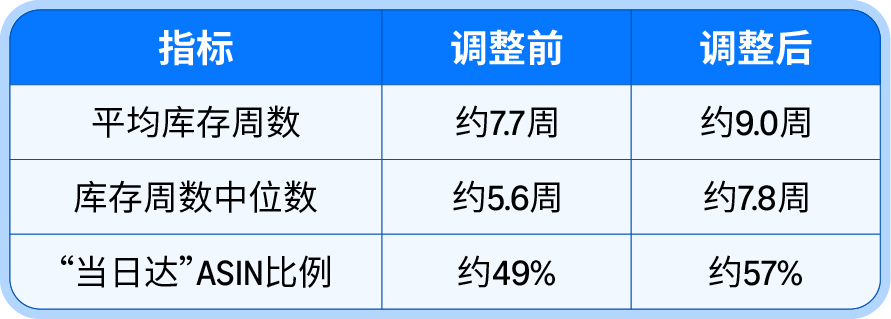
About 68% of ASINs improved stock weeks, and 65% improved same-day delivery share. The 18 ASINs under 5 weeks rose from 3.3 to 7.1 weeks on average, 89% improving. Another 15 ASINs moved from lagging to comparable or leading.
This was not from storewide stocking. Some seasonal products with over 10 weeks and low speed sensitivity saw stock weeks fall.
The core was redistributing inventory: stock enough where needed, avoid overstocking where not.

If starting over, the seller suggests three things:
First, diagnose bottleneck ASINs. Use delivery performance and manager analysis to find overlooked products. Prioritize high sales contribution but slow delivery.
Second, check inventory distribution. Look beyond total stock. Check whether core ASINs are concentrated in few centers and whether goods are receiving, transferring, or sellable.
Third, benchmark top competitors. Besides product, price and reviews, compare customer-facing delivery dates to find gaps.
We asked him to summarize delivery speed. He said:
Fast is the best advertisement. Letting customers experience products faster is the greatest responsibility to their buying experience.
That is the core: not buying this “ad slot” for all products, but prioritizing those customers really buy because of speed.
If you have any Amazon questions, contact the official client development manager via link or QR code: