
 Cross-border E-commerce Excellent Craftsman School
Recently, many sellers noticed a new feature on Amazon: below the main image and above “About this item,” Alexa now shows a product highlights summary. It displays three bullet points with green checkmarks, labeled “Summarized from product information.”
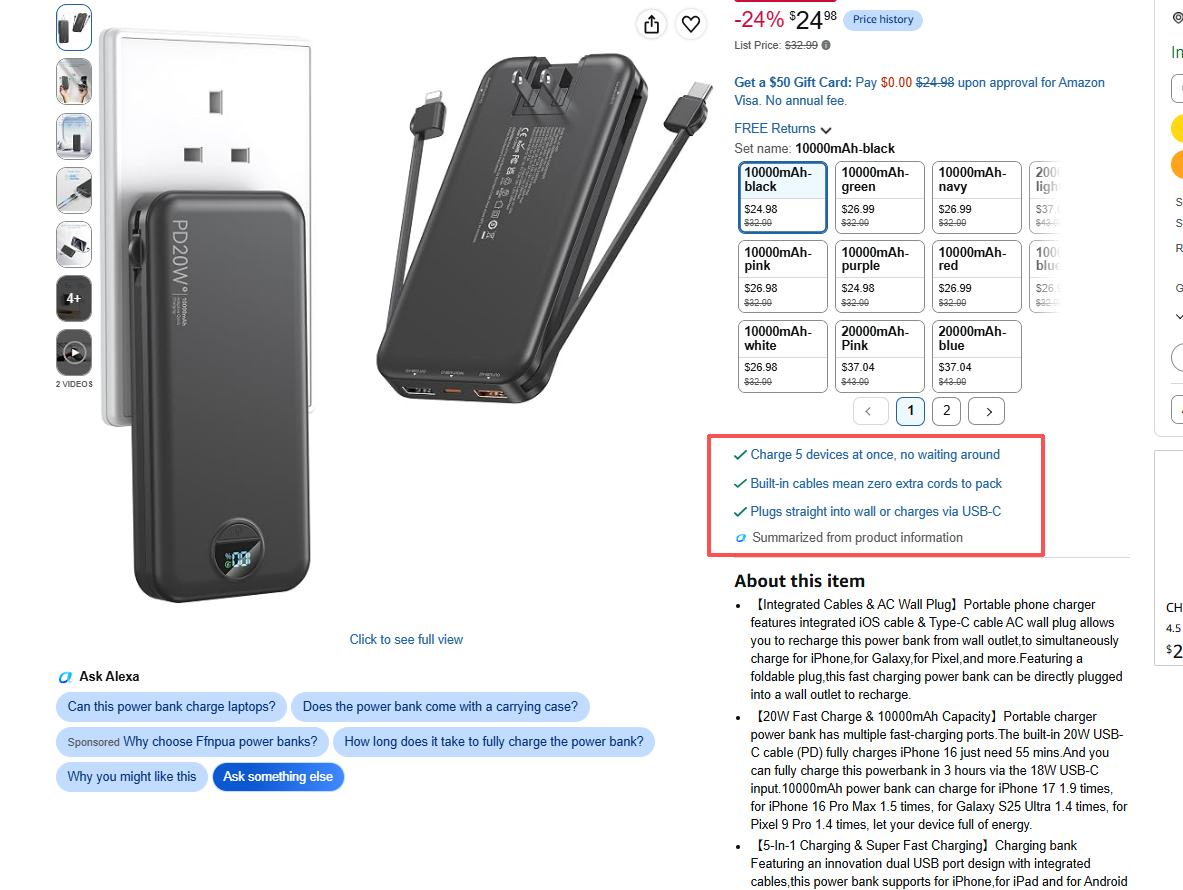
Image source: Amazon
Buyers can now see Amazon AI’s core selling points in addition to the seller-written title and bullets. Clicking the summary also lets buyers ask Alexa follow-up questions.
This seems like a small change, but sellers should ask: What has Amazon AI distilled from your listing? Are these the points you most want buyers to see?
1. What do the three summary points cover?
Take a power bank with built-in cables as an example.
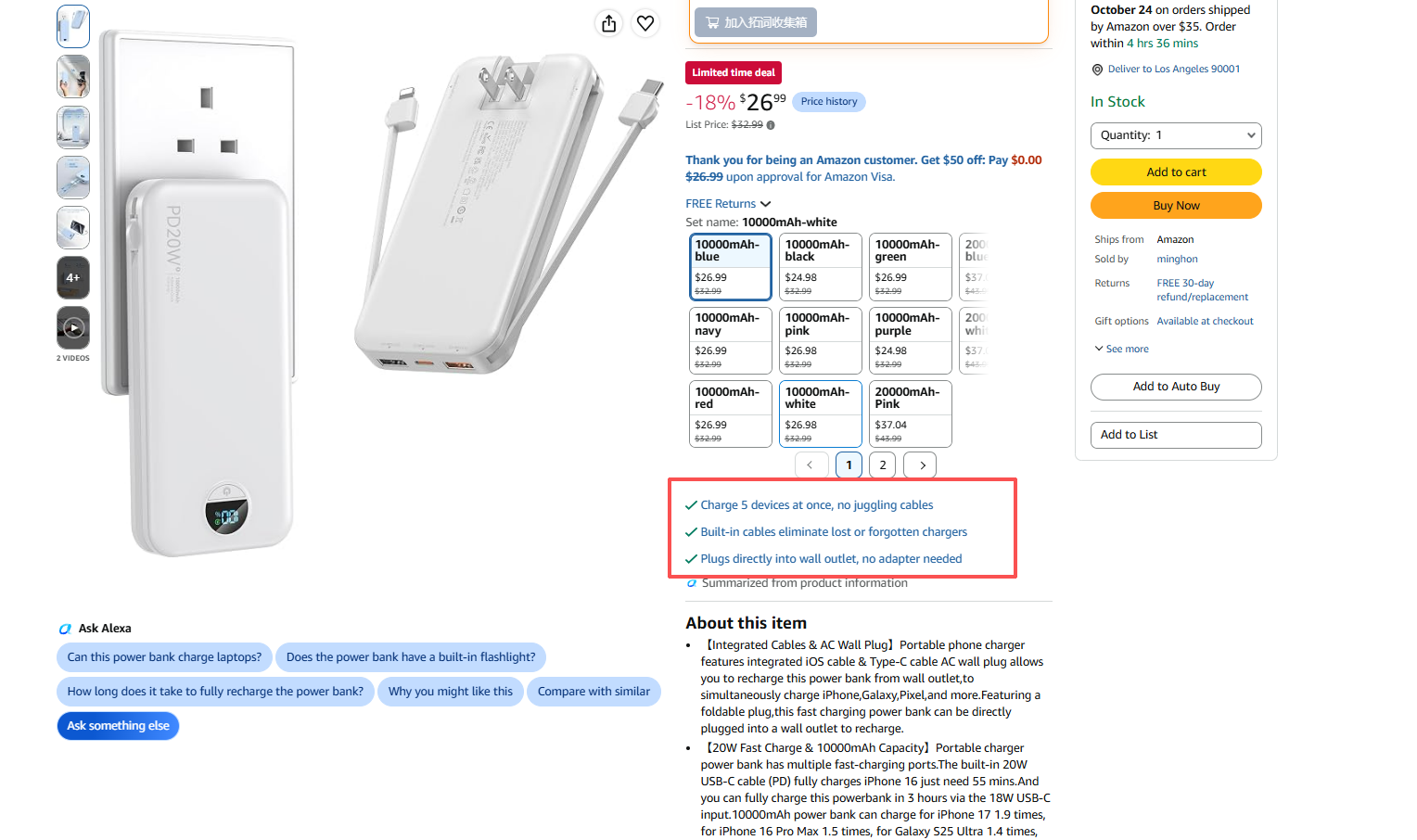
Image source: Amazon
Alexa gave only three points:
Charge 5 devices at once, no juggling cables.
Built-in cables eliminate lost or forgotten chargers.
Plugs directly into wall outlet, no adapter needed.
Compared with the original title and bullets, the AI omitted nearly all specs—20W, PD, 10000mAh, 55 minutes, 3 hours, charging counts by device. It did not repeat appearance, color, or capacity. Instead, it combined features with real consumer needs and distilled three short, intuitive buying reasons. Each is a “scenario + benefit,” not a spec.
For example, built-in cables are a feature, but the AI highlighted the problem they solve: avoiding forgotten cables. Direct wall charging emphasizes convenience. These points answer likely buyer questions: How many devices can it charge at once? What hassle does it solve? Do I need extra accessories?
This is faster than making buyers read long descriptions. Note: this module is not yet shown on all pages; visibility may vary by account, device, or ASIN. It is still in testing and not a fully rolled-out uniform feature.
At the bottom left, there is also an Ask Alexa module with preset questions:
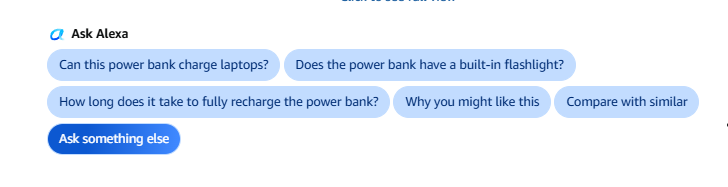
Image source: Amazon
Can this power bank charge laptops? Does it have a built-in flashlight? How long does it take to fully recharge? Why you might like this? Compare with similar items.
These are common pre-purchase concerns. They signal two things:
1. Buyers will increasingly ask AI directly rather than reading titles, bullets, and reviews.
2. AI answer quality depends on whether your listing clearly explains these points.
2. What does this change mean? What should sellers do?
First, because the summary appears early and is easy to read, many buyers will use it for initial screening. The first impression may come from AI’s three lines, not your title or bullets.
Second, whether your selling points can be captured by AI is now as important as whether buyers can understand them. Sellers should ensure core functions, use scenarios, and differentiators can be accurately identified and extracted.
Listing features and user needs must be connected clearly, not just listing specs and keywords.
Third, since the summary is generated from existing product information, problems start with the listing. If the listing is unclear, AI’s summary may miss your intended selling points.
Amazon has not disclosed exactly which fields Alexa uses or their weight, so the above is based on frontend observation. Check multiple ASINs to verify.
First check whether AI captured core selling points. Select core ASINs and see if the module appears. If it does, verify three questions:
Does the AI summary accurately reflect the product’s real functions?
Are the extracted points what buyers care about most?
Are your key differentiators reflected?
If all three are accurate and support purchasing reasons, keep observing. If the summary misses the point, optimize the listing by clarifying unclear content and strengthening core advantages.
3. How to make AI recommend you
What should sellers do to make Alexa recommend your listing?
1. Listing copy: write “reasons to recommend you.” Titles and bullets still need keywords, but key copy must describe audience, scenarios, and pain points so AI can find reasons to recommend you, not just keywords.
2. Images: let AI “understand” your product. Many sellers focus only on CTR and conversion, but for AI, images are product information too. Some selling points can be recognized from product structure, usage, people, and scenes. For example, a mother using a product with children may signal family/child scenarios. For storage products, showing small wardrobes, dorm rooms, or rental rooms helps AI learn usage environments. Image design should serve two goals: conversion (first 2-3 images): explain what the product is, core benefits, why it is worth buying, and how it beats competitors. AI understanding (later images): add user identity, usage scenarios, usage methods, suitable spaces, and problems solved. Simple self-test: ask AI to describe the image and identify target consumers and shopping needs; if it differs from your intent, adjust the image.
3. Fill in Search Terms fully and accurately. Besides title, bullets, and A+, backend attributes and Search Terms are often ignored but are basic data for AI. Complete as many fields as possible, but do not add irrelevant scenarios for traffic, or AI may misread the product. Accuracy matters more than volume.
4. Reviews and Q&A: hidden real user language. Reviews affect conversion and Q&A answers questions, but they also contain real user language. Users may not say “I need small-space storage,” but “my room is small, it fits under the bed.” That is a clear scenario. Analyze your own and competitors’ reviews and Q&A to extract user identity, scenarios, purchase reasons, pain points, and complaints, then feed them back into listings and images.
Alexa summaries show Amazon is using AI to “read listings for buyers.” The change is not whether to optimize listings, but what to optimize: from search rankings to being understood, paraphrased, and recommended by AI.
Those who explain product value more clearly, specifically, and truthfully will be more likely to appear in those three lines and be selected by AI recommendations.